
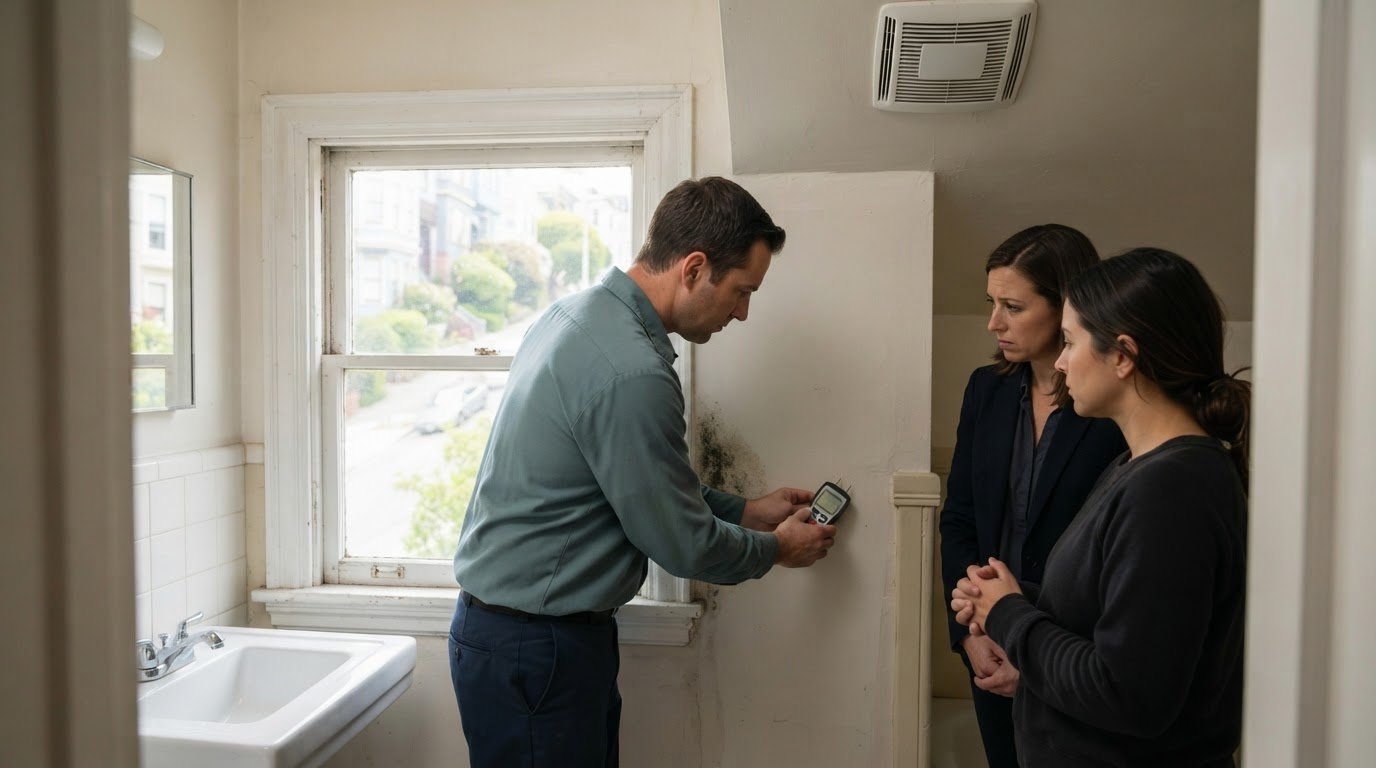
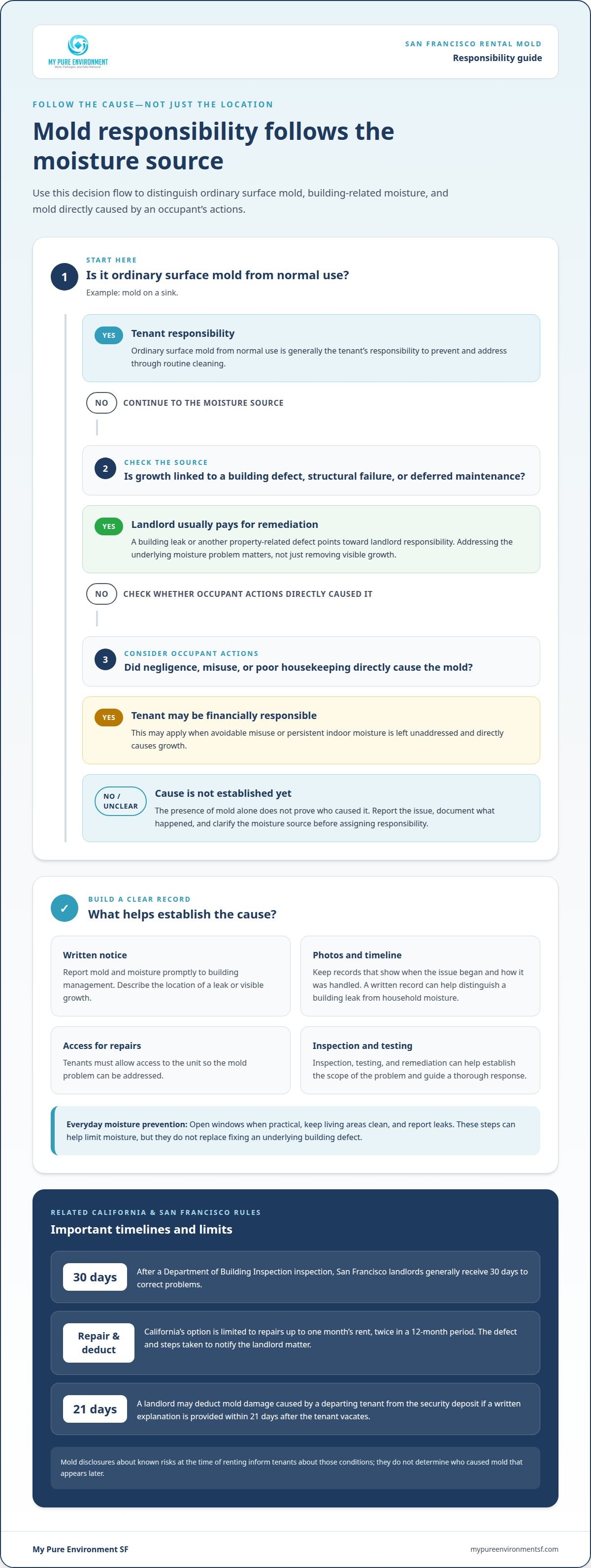
San Francisco property management mold policy generally turns on what caused the growth: landlords usually pay for remediation when mold stems from a building defect, structural failure, or deferred maintenance. Tenants may be financially responsible when negligence, misuse, or poor housekeeping directly caused it. Ordinary surface mold from normal use, such as mold on a sink, is generally the tenant’s responsibility. The key is to identify the source and address the underlying moisture problem.
It’s understandable to want a clear answer before deciding what to do, especially when a leak or visible growth affects your home. This article explains how responsibility can differ, why reporting the issue and documenting its cause matter, and what California and San Francisco rules say about habitability and security deposit deductions. It also explains how mold inspection, testing, and remediation can help establish the scope of the problem and inform a thorough response.
Key Takeaways
- Responsibility for mold remediation usually turns on what caused the growth: a building defect or an occupant’s actions can lead to different outcomes.
- Report mold and moisture problems in writing, since clear notice and records can help establish when the issue began and how it was handled.
- California’s repair-and-deduct option has limits, so understand its conditions before paying for repairs yourself.
- Security-deposit deductions depend on tenant-caused damage and timely written accounting, not simply the presence of mold.
- Testing, inspection and remediation can help identify the extent of mold and address the problem more systematically.
Tenant liability for mold caused by negligence or poor housekeeping
Tenant responsibility depends on whether the tenant’s actions caused the mold, not simply where it appeared. Reporting moisture promptly and distinguishing ordinary surface mildew from damage can help clarify who may be responsible.
Tenant Moisture Prevention Duties
Tenants can help limit everyday moisture by opening windows when practical, keeping living areas clean, and reporting leaks to building management. These steps matter: an unreported drip beneath a sink can keep a cabinet damp, while routine cleaning can address surface mold that develops through normal use.
For example, a tenant who notices a leaky pipe should notify management in writing and describe its location. This record can help distinguish a building leak from moisture linked to household use. Tenants must also allow access to the unit to address a mold problem.
Negligence and Tenant-Caused Mold
Negligence or poor housekeeping can create tenant liability when it directly causes mold growth. Persistent indoor moisture left unaddressed, or avoidable misuse that keeps materials wet, may support that conclusion. The presence of mold alone does not establish who caused it.
The distinction matters in everyday situations. Ordinary mold on a sink from normal use is the tenant’s responsibility to prevent, while a reported pipe leak points to a different cause. Written notice, photographs, and a clear timeline can document what happened without assigning blame before the source is understood.
How quickly must a San Francisco property manager respond to a tenant’s mold complaint? The applicable correction timeline depends on the process involved; after a Department of Building Inspection inspection, San Francisco landlords generally receive 30 days to correct problems. Tenants should report suspected mold and active leaks promptly, rather than waiting for an inspection.
When must San Francisco landlords hire a licensed mold assessor or remediation contractor? The rules described here do not establish a specific licensing trigger. For reported mold, San Francisco landlords are advised to arrange testing and cleaning, then document professional remediation.
California landlords must disclose potential mold health risks and impacts to prospective tenants in writing; providing the state mold booklet fulfills this requirement. Landlords who know or have reason to know that mold exceeds permissible exposure limits or poses a health threat must disclose it in writing before signing a rental agreement. These disclosures inform tenants about known conditions, but they do not determine who caused later mold growth.
Security-deposit responsibility turns on whether a departing tenant caused mold damage, not merely whether mold was found. California landlords may deduct mold damage costs caused by a departing tenant from the security deposit if they provide a written explanation within 21 days after the tenant vacates, according to California Legislative Information. A written explanation connects the deduction to the claimed damage and gives the tenant a record of the landlord’s reasoning.
California and San Francisco habitability laws
California habitability rules address whether rental housing remains fit to live in, while San Francisco rules provide local routes for documented mold problems. The appropriate remedy depends on the condition, notice, and landlord response.
California’s Habitability Warranty
California’s implied warranty of habitability requires landlords to maintain rental homes that meet basic living standards. California Civil Code Sections 1941-1942 and San Francisco housing and health codes define landlord obligations. For tenants, the warranty matters when moisture or mold reflects a condition the landlord must address, rather than a cosmetic concern alone.
A tenant may use repair and deduct to pay for repairs up to one month’s rent, twice in a 12-month period, according to California Legislative Information. This remedy has limits, so the nature of the defect and the steps taken to notify the landlord matter. Keep written notices and repair records together.
Mold Disclosure Requirements
California landlords must disclose potential mold health risks and impacts to prospective tenants in writing. Providing the state mold booklet fulfills this requirement. Landlords who know or have reason to know that mold exceeds permissible exposure limits or poses a health threat must disclose it in writing before signing a rental agreement.
These disclosures concern known risks at the time of renting; they don’t establish who caused mold that appears later. A prospective tenant can keep the written disclosure with the lease. A tenant reporting new growth can describe its location and any moisture source in a separate written notice.
Conditions Affecting Rental Habitability
Mold may raise habitability concerns when visible or otherwise demonstrable growth is connected to a serious condition affecting the home’s use or safety. The extent of growth, evidence of ongoing moisture, and the landlord’s response help distinguish a substantial problem from isolated surface mildew.
San Francisco tenants may sue under city nuisance laws for failure to remove visible or otherwise demonstrable mold inside buildings, under Police Code Section 581(b)(6). The San Francisco Department of Public Health doesn’t conduct mold testing, but holds property owners accountable for mold growth in rental homes. For persistent growth, professional mold remediation addresses the mold condition itself.
Tenant Rights When Mold Goes Unaddressed
If a landlord fails to address a serious cited violation, California Civil Code Section 1942.4 restricts rent collection. According to California Legislative Information, a landlord cannot ask for or collect rent when serious cited violations remain uncorrected for at least 35 days after an order to correct them. The statute also provides for statutory damages of up to $5,000 in a habitability lawsuit, according to California Legislative Information.
Tenants may also petition the San Francisco Rent Board for a rent reduction when services in rent-controlled housing decrease. Repair and deduct is another limited route, but it isn’t a substitute for documenting the problem and giving notice. Keep copies of communications, inspection findings, and repair records so the timeline and condition are clear if a dispute arises.
Landlord responsibility for mold caused by structural defects
When mold follows a building defect, responsibility generally rests with the landlord. The cause, repair history, and tenant notices help establish who must address the condition.
Structural Defects and Landlord Liability
California landlords generally pay for remediation when mold results from structural failure, deferred maintenance, or a building defect. A roof leak, damaged plumbing, or recurring water intrusion can keep building materials damp and allow mold to develop. The landlord’s responsibility is especially relevant when the tenant previously reported the leak and it wasn’t repaired.
Notice matters. Tenants should report mold in writing before expecting the landlord to address it, and include the location, visible growth, and any related leak. A dated message describing water under a window, for example, creates a record connecting the reported defect with the affected area. Keep a copy of the message and any response.
Prevention and Remediation Duties
Landlords must maintain habitable housing, and California Civil Code Sections 1941-1942 and San Francisco housing and health codes define those obligations. For mold linked to a structural defect, the practical response is to address the reported condition, arrange testing and cleaning, and document professional remediation. Removing visible growth without resolving the moisture source can leave the underlying problem in place.
What are San Francisco landlords’ legal duties for mold prevention and remediation? They must maintain habitable homes, address reported mold conditions, and correct building defects that cause moisture. San Francisco landlords are advised to have reported mold tested and cleaned, then retain documentation of professional remediation.
After an inspection by the San Francisco Department of Building Inspection, landlords generally receive 30 days to correct problems. That period applies after an inspection, not as a universal response deadline for every tenant report. The cause and inspection findings shape the required corrective work.
Property Documentation and Prevention
Good property records connect the first report, inspection findings, repairs, and remediation. Landlords can document leaks during move-in, general maintenance, and turnover inspections, then keep dated notes of observed moisture and completed work. Records showing a recurring ceiling leak across inspections can help identify a building issue before mold spreads.
What are best practices for documenting and preventing mold in San Francisco rentals? Record inspection observations, tenant notices, leak repairs, testing, and professional remediation in a consistent property file. Tenants can support that record by promptly sending written reports that describe where moisture appears.
How can tenants file a mold complaint with San Francisco housing authorities? They can report the condition to the Department of Building Inspection and seek an inspection, which can document serious violations. Keep the written tenant notice and related records together to show the timeline and the landlord’s knowledge.
Landlord responsibility to provide habitable housing
California Civil Code Sections 1941-1942 and San Francisco housing and health codes define landlords’ obligations to maintain habitable homes. For a mold complaint, the practical focus is the condition’s source, its effect on the home, and whether building problems remain unresolved.
A landlord’s response should address more than visible discoloration. If a roof leak, plumbing failure, or building defect is contributing moisture, cleaning the surface alone won’t correct the source. The repair record should connect the reported condition with inspection findings and work performed, showing that the response addressed the building condition, not just its appearance.
San Francisco landlords are advised to have reported mold tested and cleaned, then document professional remediation. Testing can help establish where mold is present and inform the scope of cleanup; remediation records can show what work addressed the affected area. These records are useful when a tenant reports recurring growth after an earlier cleaning.
The San Francisco Department of Public Health doesn’t conduct mold testing, but holds property owners accountable for mold growth in rental homes. That distinction matters: a health complaint and a mold test are separate processes. A landlord’s property file should identify the report, the inspection or testing arranged, the findings, and the corrective work completed.
For example, a tenant reports a damp bedroom wall after rain. A useful response record would include the report date, the affected wall, inspection observations, the identified moisture source, and the repairs and remediation completed. If the wall becomes damp again, comparing the new report with the earlier record can help reveal whether the source was resolved.
- Record the report: Keep the tenant’s written notice and note the room or surface involved.
- Document the condition: Record inspection findings and any identified leak or building defect.
- Track corrective work: Retain testing, cleaning, repair, and professional remediation records.
- Review repeat reports: Compare later moisture reports with earlier findings and completed work.
These steps help distinguish a corrected surface issue from a continuing building problem. A record of cleaning without information about the moisture source may not explain why growth returned. Documentation that follows the issue from the first report through testing, cleanup, and repair gives landlords and tenants a clearer account of the condition and response.
Habitability concerns depend on actual conditions, not a mold label alone. San Francisco property owners should treat reported growth as a reason to assess the affected area, investigate moisture, and preserve remediation records. This process supports a clearer response if tenants later report damage or recurring mold.
Mold-related security deposit deductions
A mold deduction depends on evidence connecting damage to a departing tenant’s actions. The condition’s cause, its state at move-in, and the landlord’s records help distinguish tenant-caused damage from a building problem or ordinary surface mold.
For a fixed-term lease, a landlord may provide the written explanation of mold damage deductions no earlier than 60 days before the lease expires. This timing concerns the explanation, not proof of who caused the mold. A clear record should identify the affected area, explain the claimed connection to tenant conduct, and distinguish that damage from pre-existing conditions.
Move-in and move-out records can help establish that distinction. Compare dated inspection notes and photographs of the same areas, such as a bathroom ceiling, window frame, or cabinet beneath a sink. A move-in photo showing a dry, intact surface and a move-out image showing new damage may support a timeline. Neither image alone identifies the moisture source, so repair and leak records also matter.
Costs need a documented connection to the mold damage being claimed. A remediation invoice, inspection findings, and notes describing affected materials can help explain the work performed. For example, a record identifying cleanup in one water-damaged cabinet is more informative than a general entry saying “mold repairs.” Keep records specific to the unit and condition.
Tenants can preserve their own account by keeping the lease, move-in inspection, written maintenance requests, and landlord responses together. If a tenant reported a leaking pipe during the tenancy, that report may be important in determining whether the resulting mold came from an unrepaired building issue. A chronology helps compare the report date, repair activity, and move-out condition.
- Compare conditions: Match move-in and move-out records for the same room or surface.
- Connect the cause: Review leak notices, inspection observations, and repair records.
- Describe the work: Keep invoices and remediation notes tied to the affected area.
- Retain communications: Save dated tenant reports and management responses with the unit file.
A deposit accounting and mold cleanup address different questions: the accounting concerns responsibility for damage, while remediation addresses the mold condition. If mold remains in a bathroom or other area, arrange professional mold remediation to address the affected space.
My Pure Environment SF
My Pure Environment SF helps property owners and tenants address mold concerns through testing, inspection, remediation, and indoor air quality improvement. These services can help clarify the extent of a suspected problem and support a focused response when mold appears in a rental home.
If growth is visible in a bathroom, bathroom mold removal can address the affected area. For broader concerns, mold testing and inspection can help assess the condition, while remediation focuses on mold removal. These services address mold and indoor air quality, not responsibility for repair costs or legal decisions about a security deposit.
If you need help assessing or addressing a mold concern, contact My Pure Environment SF.
Move from uncertainty to a clear next step
A clear San Francisco property management mold policy should help people focus on what comes next: understanding the condition, its likely source, and the practical work needed to address it. Tenants can keep communications and observations organized. Property owners can treat a reported concern as a reason to assess the affected space and determine an appropriate response.
When the source or extent of mold remains unclear, an assessment can provide useful information for planning. My Pure Environment SF offers mold testing and inspection, remediation, and indoor air quality improvement to help address mold concerns in residential spaces. This work can complement property records, but it doesn’t determine legal responsibility or resolve a dispute over a deposit.
If you’re ready to discuss a mold concern, contact My Pure Environment SF. A thoughtful next step can make the path forward easier to understand.
Frequently Asked Questions
Who Pays for Mold Remediation?
Usually, responsibility follows the cause of the mold, not simply its location. If a building leak or structural defect produced the growth, the landlord generally pays for remediation. If a tenant’s negligence or misuse directly caused it, the tenant may be financially responsible. Growth around a reported window leak, for example, raises different questions than persistent moisture caused by tenant actions. Records help clarify how the condition developed.
What California laws and San Francisco ordinances govern mold in rental housing?
California habitability duties are addressed by Civil Code Sections 1941-1942, while San Francisco housing and health codes also apply to rental conditions. San Francisco’s Police Code Section 581(b)(6) concerns nuisance claims involving visible or otherwise demonstrable mold inside buildings. California disclosure rules address known mold risks before rental agreements. Together, these provisions concern housing conditions, disclosure, and possible remedies. A San Francisco property management mold policy should account for these distinct legal functions.
What steps should tenants take to report mold to a San Francisco landlord or property manager?
Send a dated written report identifying the room, affected surface, visible growth, and any nearby moisture or leak. Attach clear photographs if available, and keep a copy of the message and responses. For example, describe whether a bathroom wall is damp after showers or a ceiling stain appears after rain. Report new changes in writing, and allow the landlord access to inspect and address the condition.
Who pays for mold inspection and remediation in San Francisco rentals?
Payment for remediation generally follows responsibility for the cause: landlords usually pay when mold results from structural defects or deferred maintenance, while tenants may be liable when their conduct directly caused it. Inspection helps identify the affected area and potential source, but does not by itself determine financial responsibility. For a reported condition, landlords are advised to arrange testing and cleaning and retain records showing what was assessed and addressed.
What penalties or legal risks do San Francisco landlords face for unresolved mold?
Unresolved mold can expose landlords to habitability disputes, nuisance claims, and tenant petitions concerning reduced housing services. A tenant’s habitability complaint may also prompt judicial scrutiny if an eviction or rent increase follows within six months. Details matter: the condition, notice, inspection findings, and landlord response can shape the dispute. A documented timeline of reports and corrective work helps show how the property owner addressed the issue.
